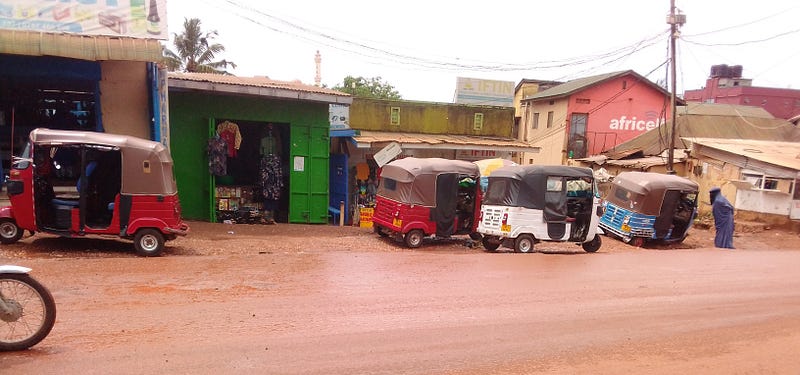
Tuktuks in Kampala.
Geofrey Ndhogezi · 27 April 2022
Tuktuks in Kampala.
In the streets of Kampala, two-wheelers swarm all available space, while matatus and cars push through the center. Rarely seen is the three-wheeler, also known as the tuktuk – popular in neighbouring Tanzania and parts of Kenya, but less commonly seen in Kampala.
Nonetheless, there are two types of tuktuks: cargo tuktuks, resembling tiny pickups, and passenger tuktuks. The passenger tuktuks can be found mainly in two neighborhoods: Kisenyi and Nateete.
In Kisenyi, tuktuk drivers and passengers are primarily immigrants – mostly Somali refugees - who have settled there for many years. Hanging around the Kisenyi area, Lubyanza saw only male tuktuk drivers, mainly carrying passengers and their belongings. The passengers are usually women, children and the elderly – similar to the situation in Freetown, Sierra Leone and other cities with passenger tuktuks.
The Kisenyi tuktuks were designed suitably for passengers, with one row of seating behind the driver enough for three passengers, and some space between the passenger seat and driver seat, enough for two medium size bags. A roof protects the driver and passengers from sun and rain.
Passenger tuktuks waiting for passengers in Kisenyi
Cargo tuktuks have a large bed that allows them to carry bigger and heavier loads than a boda boda, and a passenger – often the goods owner or loader – can squeeze onto the driver's seat or sit with the goods in the bed. When the tuktuk is heavily loaded, the owner of the cargo can travel by bodaboda and let the trusted tuktuk driver deliver the cargo to the agreed destination.
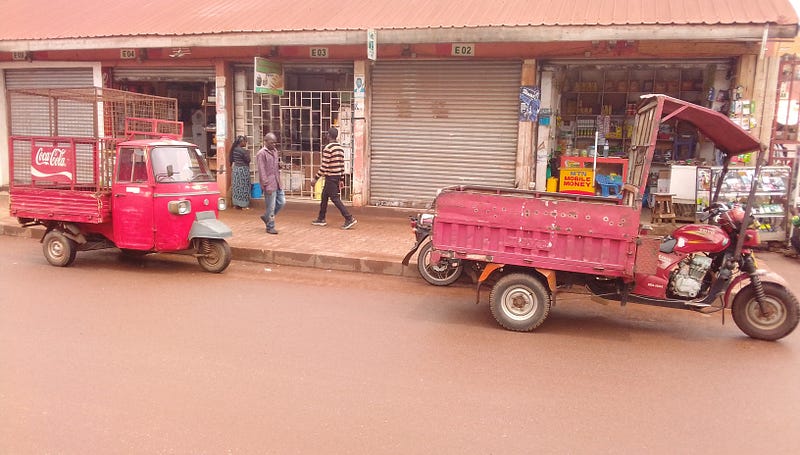
Cargo tuktuks waiting for delivery jobs in Luzige Zone, Kampala.
Many tuktuks, whether for passengers or for cargo, have permanent parking spaces similar to boda stages. However, some which belong to shop owners can be parked in front of the shops. These cargo tuktuks linked to specific shops are either driven by the shop owner or a person trusted by the owner. This person carries merchandise for his boss and for other people at a fee determined by himself.
Opio Pinato, one of the cargo tuktuk owners in Kisenyi, owns two shops selling eggs wholesale. Opio drives his own tuktuk to collect eggs from his suppliers, and to distribute the eggs to his customers.
There are many driver-businessmen like Opio around Kampala, using their tuktuks to run their businesses. They often deal in small goods, such as household goods and foodstuffs.
One of the largest stages of tuktuks is on Nakawuka Road, Nateete.
"Some time ago these tuktuks owners had strife with taxi drivers of the nearby taxi park over passengers,” says Robert Ssendi, a regular passenger on the tuktuks, “but now it seems to have been settled.” Similar to those in Kisenyi, the majority of tuktuks here are for passengers. According to Ssendi, however, the tuktuks in Nateete were retrofitted to carry five passengers instead of three.
Yuda Kamulegeya, a tuktuk driver in Nateete, who is a former boda rider, prefers driving tuktuks over bodabodas, citing better safety and earnings.
He also said that delivery tuktuks earn more money compared to passenger tuktuks because passengers are very few these days – possibly connected to the ever-continuing expansion of the bodaboda fleet in Kampala.
When Lubyanza asked about how to acquire a tuktuk, he said that Boda Banja – one of the largest yet quietest motorcycle loans facilities, linked to the Bajaj motorcycle sales company - offers loans. Potential buyers must provide 3.5 million UGX ($995) upfront, and then pay 104 installments of 165,000 UGX ($47) each week.
According to Yuda, in 2019 tuktuk operators at Nakawuka Road stage had a scuffle with taxi drivers for two days until Kampala Metropolitan Police Commander Moses Kafeero intervened. Commander Kafeero stopped the taxi drivers who were attacking tuktuks, allowing tuktuks to get back to work from their stage. Yuda cautioned that no one should attempt to start a stage for tuktuk anywhere else because the taxi operators won't allow. He gave an example of a stage which was started on Busaabala Road and attacked by taxi operators the same week. Without police support, the stage crumbled, and to date no one is working there.
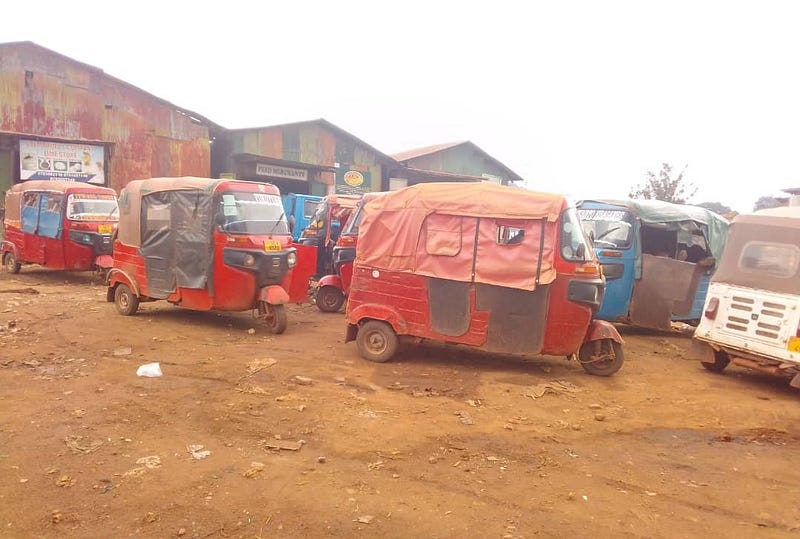
Passenger tuktuks waiting for passengers at their stage on Nakawuka Road, Nateete.
Yuda said that they have three stages under one management and there are two female drivers. To become a member on their stage you pay one million shillings. After becoming a member you can have access to their tuktuks on kibaluwa arrangements and pay 30,000 Ugx to the owner daily. But if you want it on loan arrangements you go to Boda Banja.
Yuda also says tuktuks are better than bodaboda in many ways. "We are respected by car drivers, rarely stopped by police, no one ever asks to see my driving licence, and I can be safer together with the passengers."
"Tuktuk also earns better than bodaboda but requires a space similar to that of a car, so a passenger who is in a hurry still chooses bodaboda. Tuktuks are suitable for passengers who come in groups, usually three people but here on Nakawuka Road we can take up to five. Passengers who are taking a similar direction can pay less on a tuktuk than on a bodaboda. For example, if I take three people to town, I can charge them 10000 Ugx, but if each uses bodaboda, the least they can pay is 4000 Ugx each."
It remains to be seen if tuktuks can take off in Kampala, or if they will continue being part-time players in the city’s transport.