How to organize bodabodas in Kampala.
Geofrey Ndhogezi · 2 April 2022
Before we go reaching for new haphazard regulations, we should first use what we have.
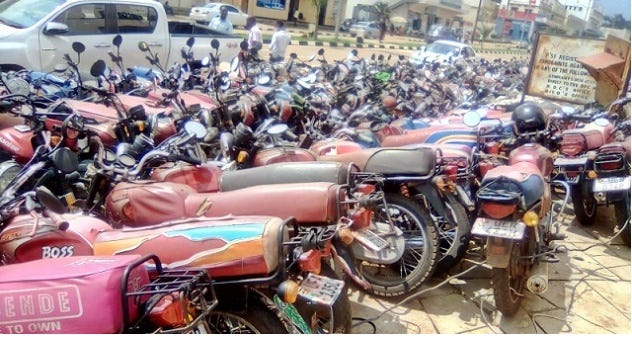
Impounded bodabodas at the Central Police station, Kampala. Photo credit: The Independent.
In the eyes of the government, the bodaboda industry is a terribly disorganized society which requires a major overhaul. So the government has often come up with plans to streamline it. In that regard, KCCA attempted to register boda riders in 2013, the parliament routinely discusses bodaboda with no long-term solutions, the president proposes installation of digital trackers on motorcycles, and regulatory efforts are regularly undermined by powerful people in government. Those efforts, which are usually flanked by harsh crackdowns on boda riders, have not helped much. Instead, they have promoted confusion and defiance through inconsistent enforcement.
While government efforts to organize the bodaboda industry are continuously misaligned, the industry relentlessly expands - receiving new riders daily, strengthening social ties between riders and their customers, securing immense funding and its benefits and downsides attracting global attention.
The contentious boda industry basically relies on a relationship between employment-seeking drivers and hustling passengers, and its growth is fueled by a common desire - convenient, timely movements. Until a better mode of transport is put in place, the organic growth of bodaboda won't cease, but continues to call for regulations that involve serious consultation with all parties.
To organize bodabodas, we don't need to wait for orders from ministers or the president. All we need is to embrace the existing structures and rules and enforce them consistently. Some of the structures that have proven regulatory potency are:
Boda stages.
Boda riders hang out, waiting for passengers at specific locations known as stages.
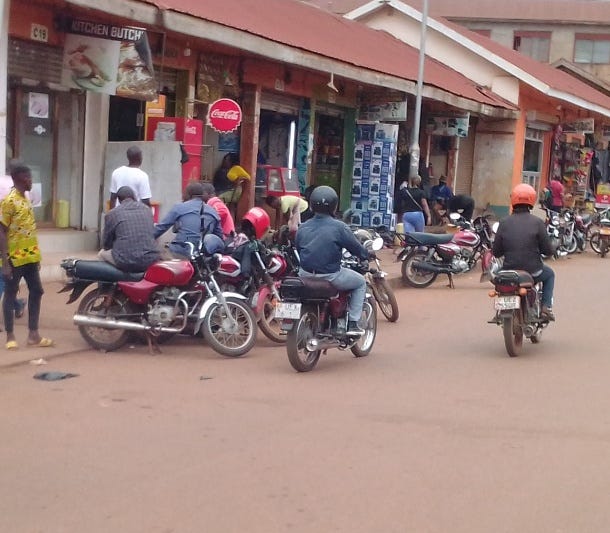
Usafi Market bodaboda stage on Luzige road, Kampala.
Though the system is largely informal, the process of becoming a member at any of the stages is arguably semi-formal. Stages have leadership committees and hold meetings where they create their own rules which govern their stages. They have punitive measures against their own wrongdoers and the people around stages can develop trust with boda riders at those stages. The boda riders deliver all kinds of items including large amounts of money, dropping and picking children from school, and even watching over other people's businesses.
They access cash loans from banks, and motorcycle loans from the rapidly growing loan schemes. Those institutions require recommendations from the stage chairperson every time a boda rider seeks their services. This demonstrates the significance of trust at boda stages.
Boda riders are known by their Local Council leaders in their areas of residence, and their workplaces, the stages, are usually recognized by the Local Council leaders where they are located.
It would be helpful if the government recognizes and empowers Stage leadership to sensitize and monitor boda riders, and enforce some of the rules with guidance and follow up provided by local authorities for accountability.
Boda apps
The introduction of ride hailing apps created the hope that boda riders would become formalized, reducing haggling over prices and improving security. That hope drove many people to suggest that it should be mandatory for every boda rider to join the ride hailing companies.
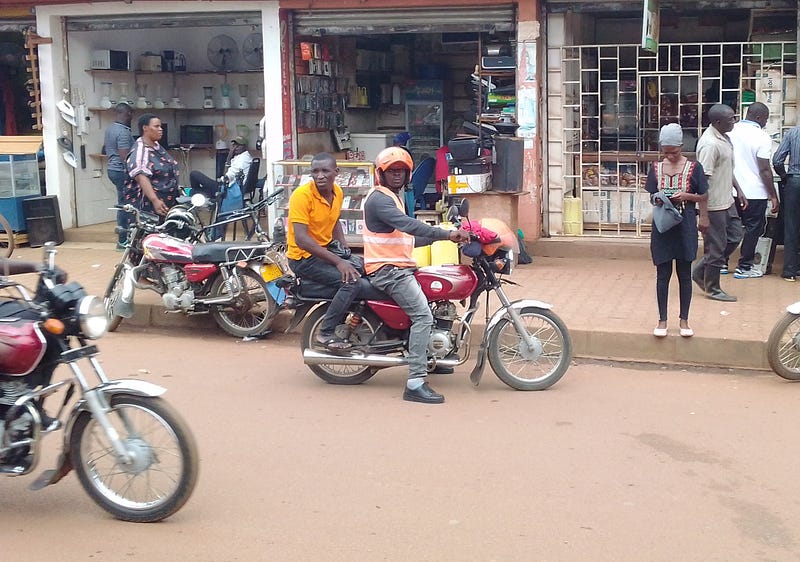
A boda rider using the Safeboda app.
Though the long-term financial sustainability of ride-hailing apps is yet to be proven, using their apps have observable benefits. Most important among these are when companies offer road safety training and monitoring to the riders.
While the apps' promises continue to be attractive, there are a lot of people who still prefer boda riders at stages, because of perceived lower cost or long-standing relationships. So there's no need to rush to eliminate boda boda stages - they can exist together. It is important to remember that ride hailing companies also prefer recruiting boda riders who are members of particular boda stages, meaning the stages are significant centers of trust.
We should encourage boda apps that enforce safety rules and provide security for riders and passengers alike.
Regulations
Boda riders' top irregularity is road misuse. They run red lights, carry multiple passengers, oppose traffic flow, and pose a danger to passengers and pedestrians.
While boda riders are good at obeying rules at their stages as enforced by themselves, they often fail to obey traffic rules despite the frequent fines and confiscation of motorcycles. The persistent irregularity is a result of impatience. While everyone seems to hate that behavior, most passengers choose bodaboda for the same maneuverability. So passengers and drivers alike need to change what they consider acceptable.
Adding more rules might not change anything. We should start by consistently enforcing the existing rules.
To do this, however, requires police reform. Low salaries mean that for many police officers, their income is heavily subsidized by extortion. Ugandans' trust in their government is beaten down by every request for “soda” from suited officers. While stages and apps can improve driver behavior, belief in the law itself depends on drivers seeing the law applied equally to all, and not simply fines going into officers' pockets. This makes this a longer-term goal.
The boda hope
Boda bodas undoubtedly have issues, road safety and security most of all. Yet they continue to play a critical role for passengers and the broader economy. Nearly everyone relies on it for either transportation or delivery, especially those who cannot afford cars. Boda riders rely on it for sustenance, fending for their families and relatives, paying their children's school fees. Mechanics and other businesses rely on it for employment and economic growth. The government collects revenue from importation of motorcycles, spare parts, and accessories.
Sensible regulation is needed. Boda riders have always expressed the desire to organize themselves at and beyond their stages. They have created associations purposely to mobilize themselves to tackle their challenges, though these often go awry with political influence from powerful individuals. However, boda riders still stand strong and ready to continue serving their customers who are never willing to let them go. We can start by building on what we already have, rather than the quarterly crackdowns that mark boda riders' lives.