Field Notes #4: Boda Bodas in Tanzania
Tom Courtright · 27 March 2022
Following the tradition of these field notes pieces, this is slightly more personal. In January, I (Tom) returned to Tanzania, where I grew up, and while most of my work has been in Uganda and elsewhere, I’ve been observing bodas here and reading everything I can find on them. Turns out, there’s very little that has been published on boda bodas in Tanzania. So here’s what I’ve learned so far.
When did boda bodas show up?
Boda bodas are only about a decade old in Tanzania now. As a result, there isn’t significant public research out yet on boda bodas. Most research has focused on the classic questions: boda bodas finances, links to safety and criminality, the potential of associations, and whether they represent the complete degradation of the youth. Generally, boda bodas in Tanzania fall along the same spectrums of financial sustainability & insecurity as elsewhere. However, there are a few interesting differences to neighboring Uganda.
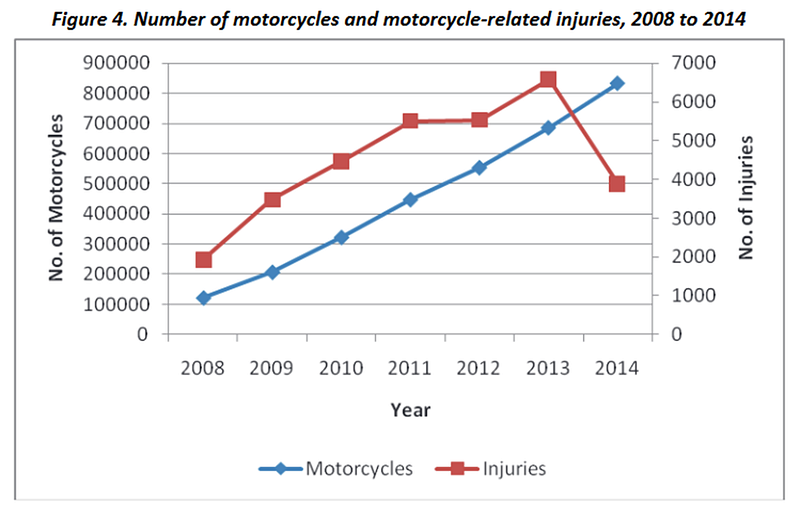
One is when they showed up. In 2008, there was just over 100,000 motorcycles in Tanzania — around 10% of the estimated number of motorcycles in Uganda which has 15 million less people than TZ. Then they took off here.
As a teenager in Moshi, Tanzania at the time, I never saw commercial motorcycles before I left in 2010. But when I returned to visit in 2013, they were everywhere. A few years later, bajajis (tuktuks) showed up, changing the landscape again.
How do they differ from Uganda?
I’ve been working on a report with Amend that included a survey of riders in Dar es Salaam, and I’ll be excited to share results when it is out in June. In the meantime, boda bodas in Tanzania are partly defined by their competition: bajajis (tuktuks). Bajajis provide a similar service to bodas, but focus more on shared, arterial services. What this means practically is that if you are on a main road headed towards town, you can get cheaper service from a bajaji. They are also shaded, and safer — so similar to Freetown kekehs, bajajis are preferred by women and children. And if you want, they will take you door to door. This means unlike Uganda, boda bodas are not the only option for door to door service, and they look worse for it.
My completely subjective and anecdotal impression is that Tanzanian boda bodas are somewhat safer. I’ve rarely felt a rider was unnecessarily speeding, nor engaging in as much high-risk behavior as is common in Uganda. Additionally, at Dar es Salaam vijiwe (stages), it’s very common that they have an additional, shared helmet that a passenger can use — which is essentially non-existent in Uganda off of the apps. At the end of the day, however, even if boda bodas drove more safely than cars, they would still be less safe — because a car’s high-speed error will maim a boda boda rider or passenger, not vice versa.
A Brief Literature Review
In the meantime, let me add some recommended reading on 🏍 in Tanzania.
· One of the first pieces of research to come out on motorcycle taxis in Tanzania was a grey paper by Tom Bishop and Peter Amos, of Amend. They detailed the role of associations in organizing drivers and their potential to improve safety. You can find it here.
· The financial benefits of boda boda work for drivers in a suburb of Dar es Salaam was detailed in a Master’s thesis by Neema Urioh in 2020. She found that owning the motorcycle improved drivers income significantly, and that renting them out was also a good business. You can find it here.
· Another Master’s thesis, this time in Chamwino District, central Tanzania, similarly found that the work was improving incomes for young men. It also addressed the rest of the ecosystem: the garages, small petrol sales, and spare parts. Written by Herieth Ngemera in 2017, it can be found here.
· Safety issues in Moshi and in Dar es Salaam were assessed in 2018 and 2019. Nothing too surprising, but the Dar study has some interesting notes on what causes crashes, while the Moshi study looks at what is associated with crashes. The Moshi study is here and the Dar study is here.
Enjoy — furahia — and let’s see where it all goes from here.