
Moto-Taxis in Thailand
Tom Courtright · 25 October 2025
Two Cities, Two Systems: First Impressions of Bangkok’s Moto-Taxis
Despite Kampala and Bangkok both being popular places to study boda bodas, if Bangkok were an East African city, it would be much more accurately be compared to Dar es Salaam. It’s huge — 17 million in the metropolitan area — it’s flat, it’s hot and humid, the street food is diverse and delicious (love a rolex but we need more, people). Similarities go further: there are more and more decent footpaths on the main roads, English is not enough to get by on, and boda bodas (motorsai) are common, but are complemented by tuktuks, buses, and a mass transit system.
Win or App
The most striking difference is the almost complete separation between two types of motorcycle taxi drivers. In Bangkok, you have win (stage) drivers and you have app-based drivers, mostly working for Grab. Win drivers were largely formalized and recognized under a 2004 legislation by previously-popular PM Thaksin Shinawatra (whose sister and daughter both became PMs after him). App-based riders seem to be more common but there are no public numbers on it.
In Kampala, apps essentially have lost so far — they remain far under 5% of trips in the city, around 1–2%. Most app drivers also take passengers from the road, or from the stage. The regulatory framework — such as it is — applies more or less the same way to everyone, which is to say, it has very little effect and is mostly viewed as a baton used by police to get money from drivers.
Not in Bangkok. Win drivers have yellow license plates, public driver’s licenses, and wear jackets with their stage, member #, and ID. App drivers mostly have regular white plates and private licenses. They’re technically operating outside the law, but they continue anyway. The scale and clarity of the rift between the app drivers and the stage drivers, though, is something else entirely.
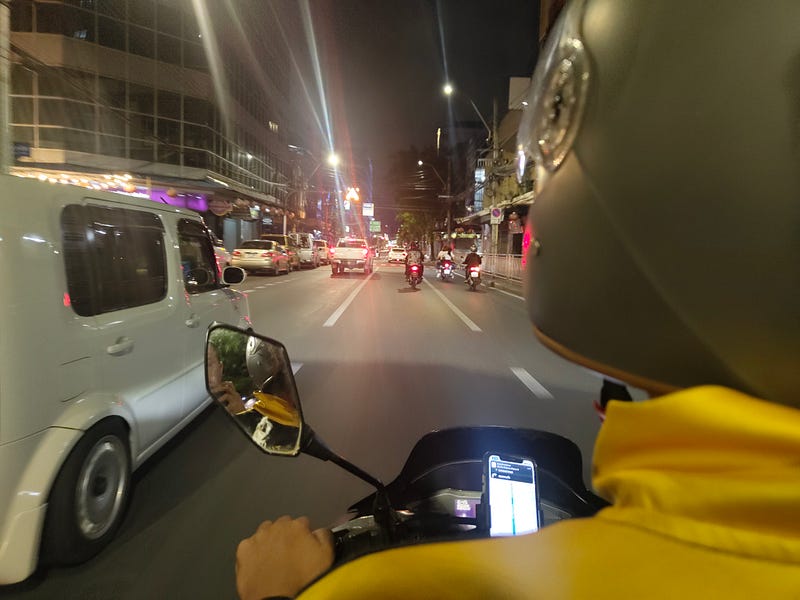
The Jacket Economy
If you want to understand Bangkok’s traditional win motorcycle taxi system, you need to understand the jackets.
These numbered vests are everything. They’re proof you’re registered with a win, approved by the Department of Land Transport (DLT), and legally allowed to operate. They’re also expensive — at some point, they were anywhere from 50,000 to 300,000 baht ($1,400 to $8,500, paid off over time, much like a stage joining fee in Kampala) depending on the location. That’s several months’ to a few years’ income for most drivers.
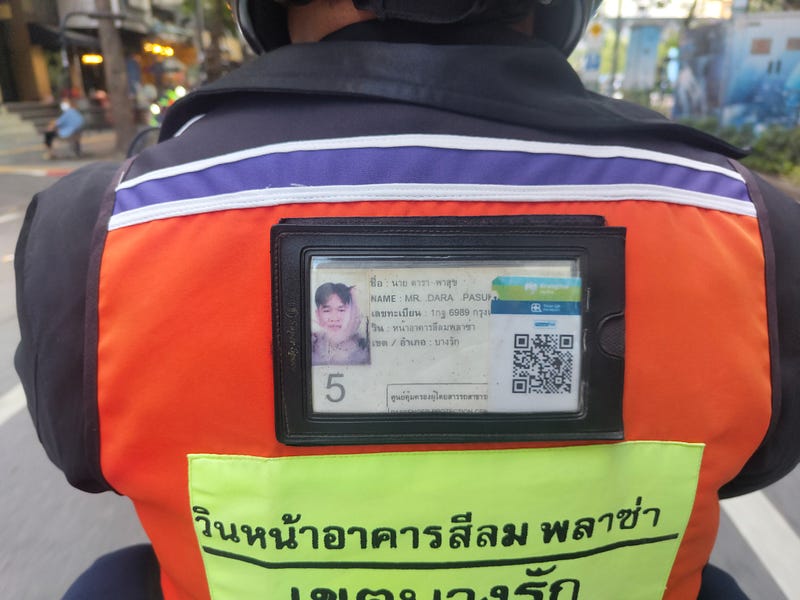
The government uses these jackets as a direct tool to limit supply. There are somewhere between 80,000 and 120,000 legal win drivers in a metropolitan area of 17 million people. Compare it to Kampala, where we have roughly 300,000 boda bodas for a metro city of 4 million. Bangkok has deliberately kept the supply of formal motorcycle taxis incredibly tight — but at the same time, it’s got a bigger share of people able to afford a car, it has a public bus system, it has a metro, it has a light rail system. It has alternatives that people can use, like Dar es Salama, unlike Kampala which has only aging minibus-taxis stuck in traffic.

The result of this government control over what is usually a very attractive labor market, of course, is that jackets became a tradable commodity. They were investments, assets that drivers could sell when they retired or needed cash or collateral for a loan. Though Akkanut Wantanasombut (Bo, as he is known locally, or Ajaan Bo to his students) tells me that trade has cooled down recently, the jacket economy fundamentally shaped how the system developed.
In Kampala, there’s no equivalent scarcity. Anyone can become a boda boda driver tomorrow if they can get a bike. That openness creates its own set of problems — oversupply, price wars, safety issues — but it also means entry is possible for people who need work. Bangkok’s system trades those problems for different ones: high barriers to entry, potential for exploitation by those who control access to jackets, and a massive informal sector (the app drivers) that exists because the formal system is so restrictive but boda bodas are still so convenient.
A Fare too Far
In another complete reversal from the informal, street realities of East Africa, the DLT sets the fares for win drivers.
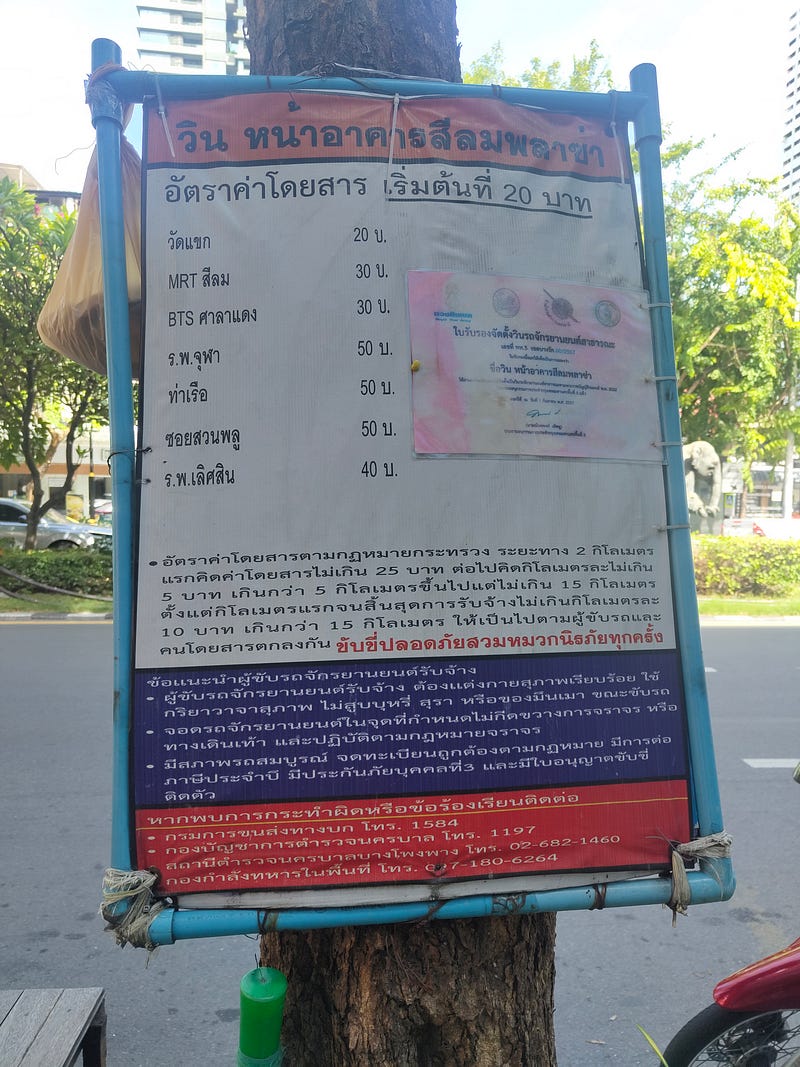
It’s 25 baht for the first two kilometres, then 5 baht for each additional kilometre up to 5 km, then 10 baht for each additional kilometre after that. While there was undoubtedly some kind of logic to this — probably setting a low enough base fare to compensate drivers for the extra time, while the longer distances are discouraged through higher fares again — the system is too complex for most people to use. Instead, every win has a fare board listing common destinations and prices. These become the de facto rates, and it’s not clear if they always match the official formula exactly. Bo described the official pricing structure as simply “too complex” for riders to enforce or passengers to verify.
Across the boda belt, setting fares is only known to have been tried once — in Rwanda, where RURA set far too low a fare for drivers. Their outrage was such that they were even allowed to protest it, and the norm has remained negotiation around broadly agreed upon pricing. Of course there’s a friction in this, a potential annoyance to customers and to drivers, but for drivers, this means that they have some control over how they price their own work (and be much more responsive to costs like the price of petrol). In Bangkok, there’s this veneer of official regulation that doesn’t quite work in practice, though creating a strange middle ground between formal rules and informal reality.
Apps are Expensive
Ajaan Bo is an activist-academic who knows more about moto-taxis in Thailand than nearly anyone else. Working closely with the Motorcycle Taxi Association of Thailand, he saw how apps came in between drivers and passengers, taking massive commissions from drivers while providing limited transparency about how their algorithms worked, not following the established laws that win drivers had mostly conformed to, and providing virtually no public data. So he and his team built an alternative.
The app uses the official DLT pricing plus a flat 5 baht ($0.15, or 500 UGX) fee. It’s structured as a platform cooperative. It even allows passengers to request only electric motorcycles, although these are few due to some of the straitjacket regulations placed on the sector. This is somewhat similar — in theory — to the Union App, launched by the United Boda Boda Riders Cooperative Union earlier this year in Kampala, which allow drivers to use it for a subscription fee of 6,000 UGX / week or a 7% commission.
However, evenwhen the app works perfectly, they face the same challenge that alternative apps face everywhere: Grab owns the market, and got there through spending probably tens of millions of dollars in promotions to attract passengers to use the service. This is massive money. When you’re competing against a well-funded tech company with an established user base, even a better product struggles to gain traction.
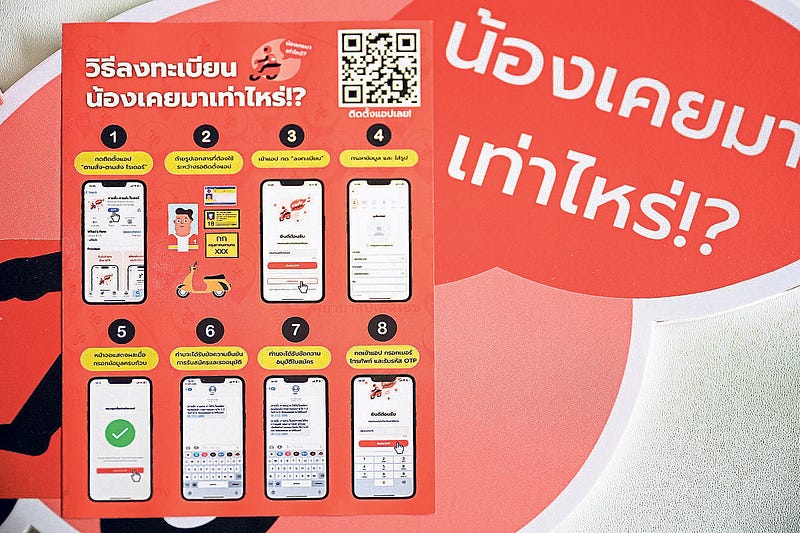
Bo and the team named the app Nong Khoei Ma Thao Rai after a phrase Thai drivers used to ask passengers: “how much was your usual fare?” The idea was to highlight how Grab’s prices had changed things, but apparently passengers mocked these old-school, offline drivers for asking this question.
In Kampala, we’ve seen similar dynamics. SafeBoda tried to build a more driver-friendly model and struggled once they tried to capture the mass market of passengers, who mostly just wanted a cheaper service.
What This Means
From a policy perspective, Bangkok’s much more formalized system still has massive cracks. The apps are only beginning to get regulated and they are still subject to less restrictions.
The tight control over formal motorcycle taxis has limited supply, which presumably means less congestion and fewer safety issues than if supply were unlimited (it helps a lot if your economy has been booming for decades and creating other jobs for mostly young male migrants to the capital). But by creating high barriers to entry, the jacket economy got out of hand, and then when apps came along without the tight control over joining the sector, every aspiring new boda driver rushed into that. The official pricing structure adds a layer of bureaucratic complexity without necessarily making the market more transparent. And the incredibly high cost of getting a ride-hailing app to mass adoption has proven just as hard a challenge here as anywhere else.
Of course, every city, and every messy, unbeatable network of boda bodas is a product of it’s past. In Kampala, the boda boda sector emerged out of the city after 1986, a city being rebuilt at the same time it was being sold off, with government trying to manage and exploit something that was already emerging.
In Bangkok, moto-taxi political activism in the 2000s gained it recognition and formality, but then set those same drivers up to fail against the onslaught of apps. The blessing of formal recognition and market entry control became a curse.