Third Quarterly Survey
Kalungi James · 16 March 2023
Executive Summary
For the third Quarterly Boda Survey, we expanded our assessment to observe helmet types, passenger helmet usage, and more. The goal is to see whether upcoming legislative changes and concerted efforts by civil society can result in higher helmet usage, better helmets, and lower fatalities on the roads. Over 6,000 boda bodas were observed over a week’s time, and 281 were interviewed. A few quick takeaways from the third edition of the Quarterly Boda Survey and the first in collaboration with Safe Way Right Way are:
Reach
In total, 28 locations were surveyed across the five divisions of KCCA and three suburb subcounties of Nansana, Kira, and Makindye-Ssabagabo. Over the course of the week, surveyors observed 6,266 boda bodas and surveyed 280 on topics primarily around ownership, helmet usage, and work expenses
Helmet usage
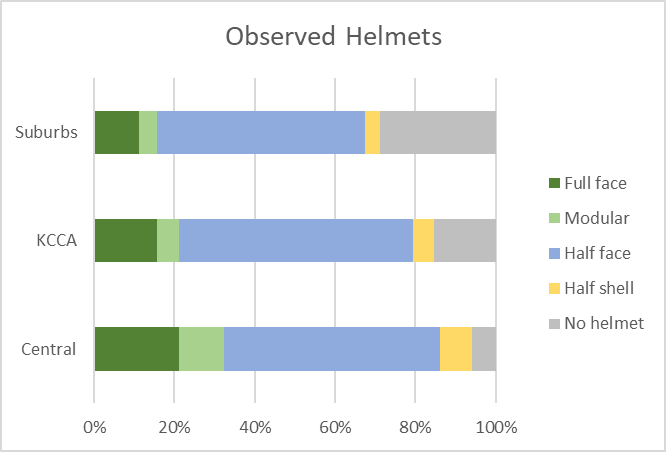
There was a slight rise in helmet usage, from 70% to 75%. As found in previous surveys, there remains a huge difference in helmet wearing from Central Division, at 88%, to the suburbs, where only 60% were observed wearing helmets. In addition, riders towards the center of the city were twice as likely to be wearing full face or modular helmets, which offer better protection for riders. Overall, however, half face helmets remain the preferred helmets by over 60% of riders. Unfortunately, passenger helmet usage distressingly low, at less than 1%.
Finances
Daily revenues and profits are around 37,000 UGX and 15,000 UGX respectively, with owners making double the profits of renters and those on lease-to-own. However, this betrays a large difference between riders who own their motorcycles outright and those who are renting or paying them off. Renters on the kibaluwa system have the lowest daily profits, of around 8,665 UGX ($2.35), while those who have used lease to own systems to pay off their bikes are now taking home around 20,166 UGX ($5.38).
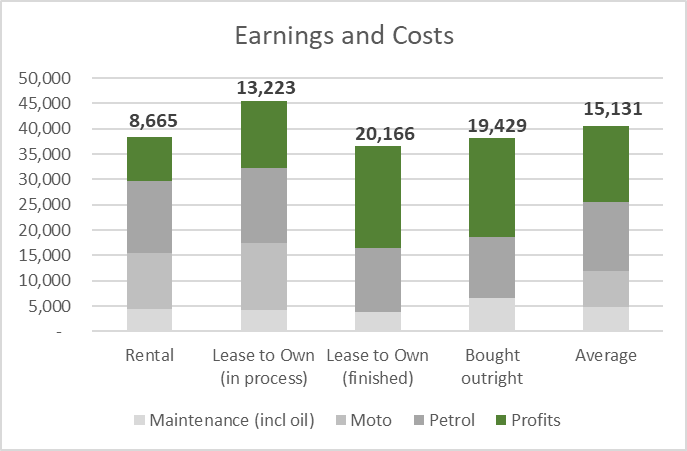
One of the more interesting findings is that revenues drop after riders finish paying off their motorcycle leases. As described by Kalungi James, boda rider and Lubyanza researcher, riders who are paying off their leases tend to seek additional daily work with the goal of ownership in mind, allowing them to relax and enjoy the fruits of their labor after paying it off.
Utilization
Utilization — defined as trips with passengers or visible loads — was around 59%, within 1% of observed utilization in October 2022. Of these utilized trips, Low utilization signals a saturated boda boda market, where there are more riders than passengers — while this can drive down costs for passengers, it encourages competition for passengers and potentially unsafe behavior.
Helmet Type, Age & Defects
Type
Similar to previous findings, half face helmets are by far the most common, making up two-thirds of all helmets on the road in Kampala. However, full face and modular helmets — which cover the chin, and thus offer full face protection — are known to be safest and provide the best protection for riders and passengers in a fall. Similar to helmet wearing overall, the highest usage of these safer helmets was observed in Central Division, where fully 34% of riders with helmets were wearing full face or modular helmets, compared to 25% and 22% in KCCA and Wakiso respectively.
Helmet age
Helmets are recommended to be replaced upon either reaching five years of age or upon becoming defect. Less than 4% of helmets surveyed had reached five years of age. Additionally, riders in Central had the oldest helmets, at an average age of 23 months, compared to relatively young 14-month-old helmets in Wakiso.
Defects
Helmet defects were least common for riders with stages in Central Division — yet around a third of their helmets still had defects. In KCCA and Wakiso, the defect rate ranged from 26%-56%.
By far the most common defect was a missing visor — 32% of all helmet owners reported missing a visor. After this, missing inner shells were the second most common defect, affecting around 11% of surveyed riders. Inner shells provide protection for the head upon impact, and missing the inner shell is a major defect that can make the helmet nearly useless.
Whether to Protect the Head
Similar to findings in October 2022, helmet wearing seems to depend on a handful of observed factors, most especially a) whether the rider is carrying a passenger, b) location, and c) police presence. Carrying a passenger seems to encourage riders to wear helmets — 78% of riders carrying passengers were observed wearing helmets, compared to 71% of riders not carrying passengers or loads.
Much bigger impact, however, was location. Riders in Central were 47% more likely to be wearing helmets than those in the suburbs.
Helmet wearing was also dependent on police presence. Locations with both a station or outpost and a visible police officer saw 87% helmet wearing, compared to 69% helmet wearing at locations without any police presence.
Passenger Helmet Wearing
Unfortunately, passenger helmet usage remains distressingly low. Of the more than 3,000 passengers observed across Kampala, only 20 were observed to be wearing a helmet: less than 1% of passengers. Once again, the safest behaviors were noted in Central, where 1.7% of passengers wore helmets, compared to 0.2% of passengers in Wakiso. Passenger helmet types were largely the same as rider helmets: two-thirds were half face helmets.
Earning a Living
We also surveyed riders on ownership and finances to assess the state of the industry and the financial prospects for boda boda riders. As seen in previous studies, the industry has moved away from rental systems towards lease-to-own agreements. In these agreements, usually with formalized companies such as Tugende, Watu, or Mogo, a rider pays a fixed weekly sum for around 18–24 months to pay off a loan, at which point they own the motorcycle outright. Today, these agreements account for 60% of motorcycles on the road, with over half of them still in the process of paying off the motorcycle.
Furthermore, boda boda earnings seem essentially stagnant. The typical rider earned around 37,700 UGX per day, up slightly from 34,800 UGX (Amend) with the bottom 10% making 20,000 or less and the top 10% making 60,000 or more. On average, costs sucked up three-quarters of riders earnings, with around 12,000 UGX going to each petrol and bike payments — however, this varied significantly depending on ownership.
Riders who owned their motorcycles profited around double what those who did not were earning. It is generally assumed most motorcycles that are bought outright are bought used, which would align with the higher maintenance costs — around 32,900 UGX / week, compared to around 15,000–19,000 for other riders. Interestingly, riders who were on a lease to own system had the highest revenues, earning around 45,000 UGX / day — possibly because they had higher costs to deal with.
The survey was carried out by Geofrey Ndhogezi and Kalungi James. The survey was designed by Tom Courtright with input from Dr. Paul Mukwaya and the surveyors. Final analysis was done by all of the above and Peter Kasaija. Data entry was also conducted by Judith Mbabazi, of the Urban Action Lab at Makerere University.