Surviving Lockdown
Tom Courtright · 25 July 2021
Boda drivers are in crisis.
In early June, rising Covid-19 cases in Kampala driven by the Delta variant resulted in an inter-district lockdown and a tightened curfew, followed by a reinstatement of a harsh lockdown two weeks later which banned all public transport and restricted movements across district boundaries.
While aimed at curbing Covid-19 cases and saving lives, the declaration was a big blow to citizens who were still nursing wounds from last years lockdown. The crisis has been most devastating for transportation workers and the family and communities their daily wages support.
Most boda riders live solely on carrying passengers. From the declaration, the president made it clear that boda riders should not carry passengers (save for the sick), which is around 90% of their work. In addition to that, boda riders are strictly not allowed to cross district boundaries. These two measures hurt citizens in several ways:
Inter-district ban
During the previous lockdown, boda riders were able to ride across districts to get food for themselves and for others. They could get food from either their own gardens or from relatives in rural areas. The current rule does not allow this to happen. Coupled with the fact that the government had no reliable relief plan, the rule makes the 42 days lockdown more cumbersome than the previous one.
Ban on passenger business
This is a complete gridlock for the boda business. Telling boda riders that they shouldn’t carry passengers is nearly synonymous with telling them to not ride at all. But the president advised that boda riders should carry only goods between 5:30 am and 5:00 pm and laid out punitive measures against the defiant.
How boda riders were piecing together delivery work and support to survive the lockdown drove Lubyanza to carry out a survey on the lockdown survival of boda riders in Kampala. Our findings indicate that delivery work has been insufficient to make up for lost passenger work, and that support from social networks has been lacking as everyone struggles in the lockdown economy.
The findings
We interviewed 40 boda riders from the 25–29 of June, selected from boda stages across the 5 divisions of Kampala, and found that drivers were struggling to keep afloat through legal work. Only around half of all drivers had either an income-making spouse, a side hustle, or daily delivery work — in normal times, these are required in addition to daily boda passenger work to keep households going (boda riders reported supporting an average of 5 dependents).
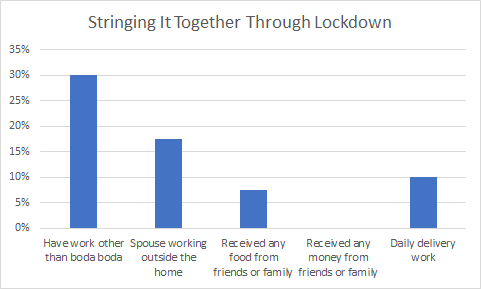
Critically, social networks were not coming through yet either: not a single driver reported receiving financial support, and only 3 had received any food assistance.
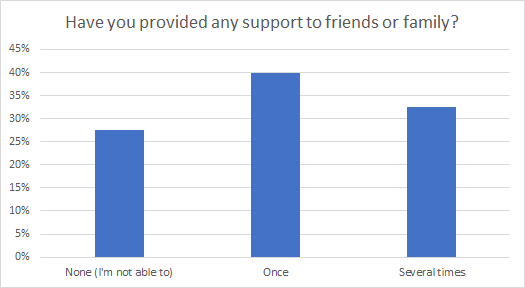
Somehow, however, most boda riders reported providing assistance to neighbors, friends or family, with 35% contributing several times and another 43% giving at least once.
Its clear that some boda riders, under pressure, are finding other means of earning to sustain their families and to assist others. Lubyanza asked boda riders how they were maneuvering through the lockdown and, in a conversation, John (not his real name) who works from a stage in Nakawa said, “I carry passengers! I can’t just watch while my children die of hunger.”
Standing along any road in Kampala, one can see the majority of boda riders are without work, carrying neither passenger nor cargo, and only an occasional boda carrying passengers. Those taking the risk have not gone unnoticed by security services tasked with enforcing the lockdown. Mr. Fred Enanga, police spokesperson, responded on June 28th:
“Acts of impatience and complacence are still prevalent within the public. The bodabodas are steadily carrying passengers, especially women, we are witnessing an increase in fake patients, excuses of going for vaccination and burials, use of fake stickers, opening of bars, etc. As a result we are also devising new tactics of additionally deploying medical teams at check points to counter fake patients, inspectorate officers to supervise the removal of number plates from non-essential vehicles parked on streets, snap checkpoints etc. Such reckless behaviors by the COVID offenders will simply increase or delay the presence of the deadly variants in the country.”
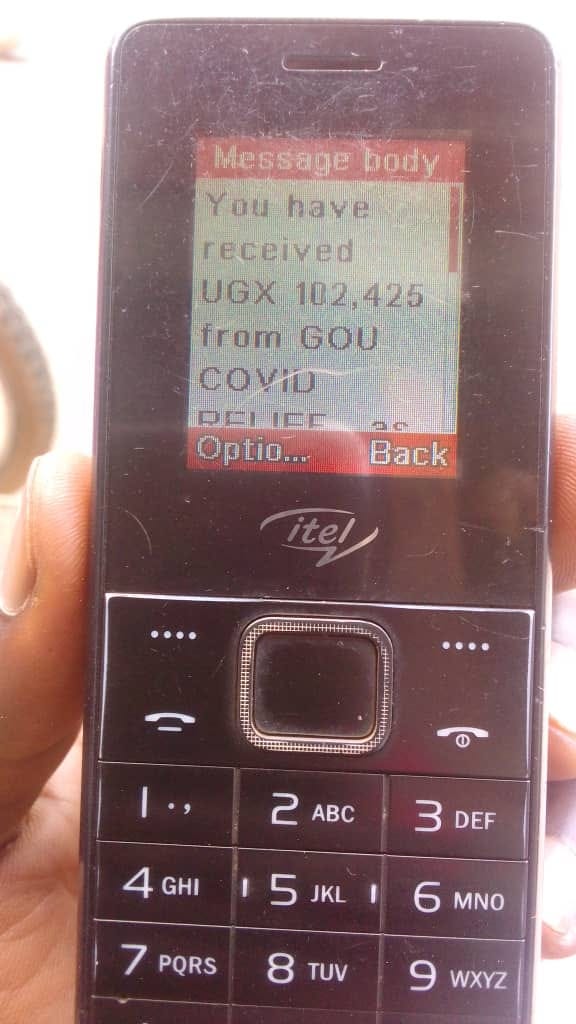
A few days into the lockdown, Prime Minister Robina Nabbanja announced plans to send UGX 100,000 to 250,553 vulnerable Ugandans via mobile money. The criteria used to determine the vulnerable and the number of the targeted beneficiaries leaves a lot of questions unanswered and a lot of people unattended to — there are over a million boda boda riders alone in Uganda, meaning most will never hear their phones ring the arrival of mobile money. For drivers who do, the relief can cover around 5–6 days of lost revenue — which translates to much less once the mugagga or the lease-to-own company is paid.
As the initial 42 day lockdown comes to an end and the question of an extension hangs in the air, it’s unlikely that — regardless of the decision— boda drivers will stop defying the rules of the lockdown to carry passengers and feed their families.