Rectifying governance-related differences might help solve the chaotic road use and the resultant…
Geofrey Ndhogezi · 19 February 2023
Reflecting on The Wheels of Change-safe and sustainable motorcycles in sub Saharan Africa, a report by the FIA Foundation, it looks obvious that motorcycle taxis, known for chaos and frequent road crashes, can be managed and the chaos can be eradicated.
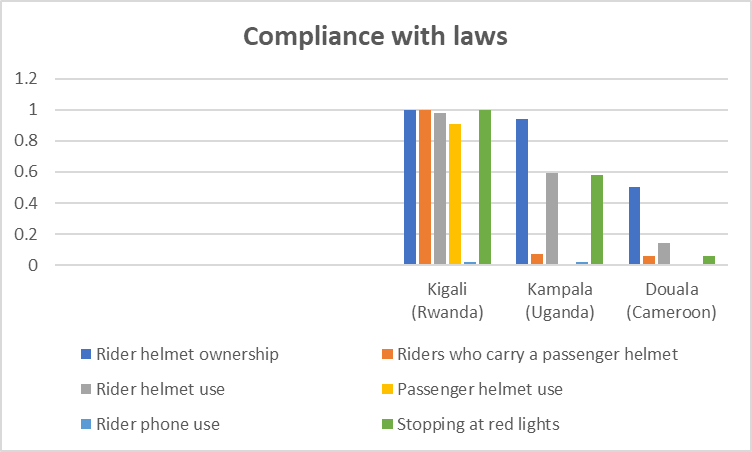
Out of the nine countries where the surveys and observations were conducted, according to the report, Rwanda’s motorcycle taxi industry is the best in terms of compliance with the laws.
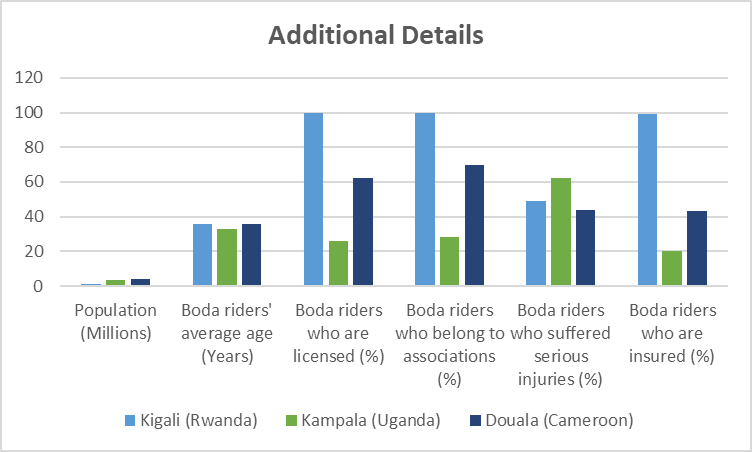
Looking at the charts, for easier comparison, I selected three cities in the order of best to worst and also concentrated on two cities, Kigali and Kampala, for further scrutiny.
It should be remembered that motorcycle taxis are a major transportation solution across many African countries and managing them calls for a bit of effort. Authorities often enforce among other things the use of helmets, possession of a driving license and third-party insurance, and obeying all traffic regulations to which the people in the respective countries seem to respond differently as seen in the charts below.
Source: The Wheels of Change
Source: The wheels of change
Much as age is a major determinant of how much risk one takes, the average age of boda riders across the sampled countries indicate that the boda riders share a common age bracket, so they are expected to take similar risks and responsibilities regardless of the population of their respective cities. But Kigali’s Moto operators are not taking the risk of running red lights.
High compliance with helmet use, observance of traffic lights, licensing and insurance, all together put Kigali’s motorcycle taxi operators distinctly ahead of their counterparts in other cities.
Comparing with countries such as Uganda, a few questions come up:
- Is it likely that if Ugandan boda riders migrated to Rwanda and did boda jobs in Kigali they would still be as chaotic as seen in Kampala?
- In Uganda, we have boda riders of Rwanda origin. Could they be the best riders in Kampala?
- What would happen if all we swapped was the governance and keep the same people in their respective countries?
These questions point at the differences in governance as the only barrier between compliance and defiance, and this brings me to suppose that rectifying governance loopholes can help improve road traffic conditions. For example, in Uganda, where a crackdown on errant road users would reduce traffic troubles, the enforcement targets extortion and maintains an environment for the chaos to thrive.
Where the authorities and government agencies would apply policy to encourage proper road use, prominent politicians side with the masses in a way that promotes defiance.
The chaos caused by motorcycle taxis is manageable.
While there are several incidents proving the boda riders’ stubbornness, it should be noted that without the politicians’ counterproductive intervention, the stubbornness can not stand consistent, diligent enforcement. Add this to continuous sensitisation campaigns and significant improvement will be realized in a relatively short time.