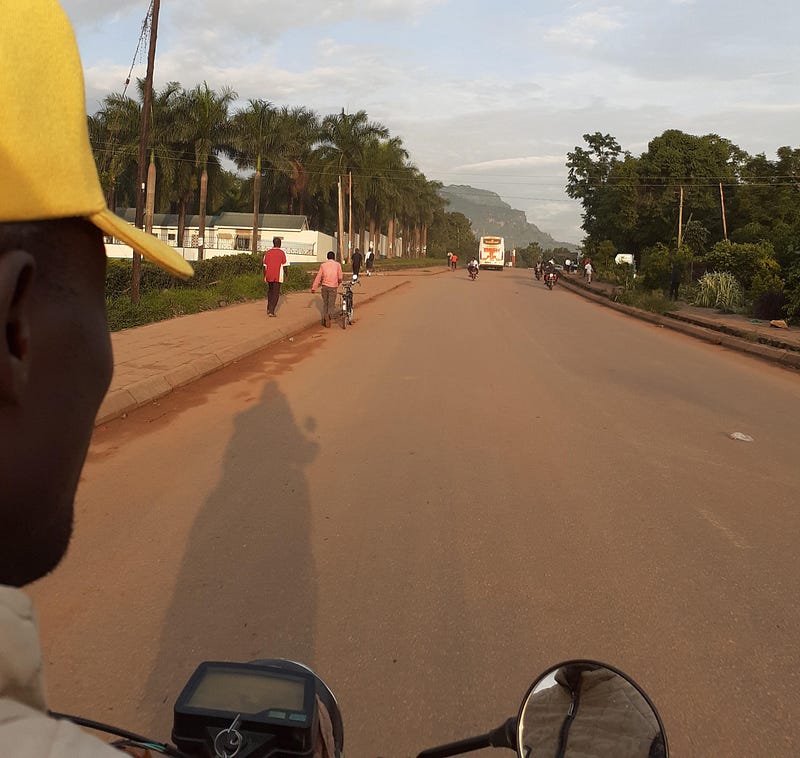
Mobility Faces Paralysis (June 15)
Tom Courtright · 10 October 2020
This article was initially sent to a Ugandan newspaper to be published during the COVID-19 ban on boda boda operations in Kampala. The newspaper ultimately did not print this before the end of the ban, and we are thus publishing it now.
How many families can do without spoons?
In his speech publicized on June 4th, the president of Uganda, H.E Yoweri Kaguta Museveni equated the purpose of boda business to the quantity of tea that can be scooped by a spoon. He was stressing that someone who is hungry can’t be helped by such a negligible amount.
I understand that the purpose of such remarks was to continue the cancellation of boda services, especially transportation of people. Initially, the cancellation of boda services was aimed at suppressing mobility because immobility is a major strategy against the spread of Covid-19.
Subsequently, as the grip of the lock down became harder, the air around the country was mixed with lamenting voices, groaning and cursing, until the president announced a partial relief, which citizens have welcomed.
The partial relief allows most of the citizens to resume their activities as long as congestion is in check.
However because the boda business, in the president’s attitude, is a negligible activity, we boda riders were told to wait until covid-19 is nonexistent. A decision which leads the nation into temptations for defiance. Because Ugandans can’t do without bodaboda!
We are aware that the globe is facing an economic shock due to the spread of coronavirus, and that we all ought to fight the pandemic together. But since the president allowed some significantly congested enterprises such as buses, taxis, and whole sale shops to operate, the idea of the indefinite boda ban sounds uninformed.
First, we should consider the public health issue.
Allowing buses and taxis to operate with 50% of their usual load capacity is still more risky than carrying a single passenger on a motorcycle in terms of spreading coronavirus.
In a taxi, a single infected person can easily spread the virus to the other eight on board since they keep exchanging air throughout the trip. Yet on a motorcycle, both the rider and passenger have fresh air every time they breath. As well, on a motorcycle, in case the spread happens, it will be from one rider to one passenger or from one passenger to one rider at a time. This means that the virus may spread at a much lower rate than in buses and taxis.
Additionally, if sanitizers and masks are entrusted with safety in buses and taxis where people are mixed up per trip, the same can be reliable and more effective on a motorcycle where only the rider and a single passenger travel together per trip.
It is quite obvious that there can’t be any distance between a rider and his passenger, but what about the nine people allowed in the interior of a taxi?
Keep in mind that most people in taxis feel like air is not enough so they adjust masks to let the nose free, lest they suffocate.
When the rider has a mask, and full-face helmet, he won’t be a threat to anyone. This is what should be emphasized in addition to washing hands with sanitisers.
Now, won’t the passenger on a motorcycle be safer?
Our leaders should also remember that most boda riders are heads of families, and that very many families depend on boda riders’ daily income! This means that keeping boda riders out of work even for a single week results in starving and violence to a hoard of Ugandans. We ought to work!
Our policy makers should first gather facts before choosing the way forward. They need to remember that everyone, including themselves, uses bodaboda!
Lastly, I’d like to inform the president that if the quantity measured by a spoon was so insignificant, people would never buy spoons.
By Geofrey Ndhogezi.
Lubyanzano.1@gmail.com