Memories of Lockdown
Tom Courtright · 28 April 2021
by Geofrey Ndhogezi
The spread of fear
“Eh! Kibi kigwana wala!”
This was my first response immediately after hearing news over the radio that Wuhan, a city in China, was facing lockdown over the spread of the terrifying killer, coronavirus.
The phrase, kibi kigwana wala, which may be translated as “trouble should remain far away”, is said in Luganda by someone who is not actually facing the trouble but only hearing about it. When I said it, I convinced myself that China was too far for the tiny assassin to reach us here in Uganda. I was wrong because the speedy spread of coronavirus proved to everyone that nowhere on earth is too far!
On a daily basis, my favorite radio station Kingdom FM informed the nation on the progress of the invasion, the radio presenters telling us about the lockdowns, the closure of borders, the thousands of daily deaths, the spread to everywhere! It was all sickening. But I was still able to comfort myself until, to my dismay, the spread unveiled in East Africa. It invaded my thoughts, and I became more nervous with every passing day.
I asked Google if there was any potent remedy, called friends to find out if they were surviving and discussed possible escape methods, but nothing seemed to help. I checked social media and all I could see was a flood of apocalyptic posts. Every platform was immersed in terror. Everyone was looking for help. There was no refuge.
I was terrified but I was still able to work and provide sustenance to my family when the worst moment came.
On the evening of March 22nd, 2020, I was at home with my wife and children when HE. Yoweri Museveni declared the total closure of all sorts of activities countrywide save for a few essential ones. My job, riding bodaboda, was not spared.
Desperation sets in
“Banange! Omwavu wa kufa!”
“Alas! The poor shall only die!” I said in fear. My wife moved closer to me. I wasn’t afraid of COVID-19 but the lockdown had taken my only source of sustenance. Terror overwhelmed me. My heartbeat amplified. My eyes opened widely. My wife could see that I was deeply worried. “We shall leave this to God,” she soothed me.
I did not think, even for a second, that dying of COVID-19 was a possibility. But I thought my children, my wife and I would die of hunger even before COVID-19 hits our area, because I had no other way of getting food besides the boda business. All I had at that moment was ten thousand shillings and a few remaining groceries, barely enough to take us through a week. I was one of the countless poor Ugandans who were only waiting to die of hunger!
When I called my friends to inquire about their situation, they all narrated stories similar to mine. Everyone said, “omwavu wa kufa” , and I realized that yes, it’s the poor who have nothing in the store. It’s the poor who have no money in the bank. It’s the poor who only survive by daily sweat. Since our daily toil was indefinitely put on hold, the poor would starve to death before we could get any cases of COVID-19.
Everyone knows that most Ugandans are under the poverty line. This is why the phrase omwavu wa kufa was everywhere around Kampala during the lockdown. And it was mainly said, out of despair, by the same poor Ugandans, watching the last meal cook on the fire with their families.
Ayi Mukama, kati tunalya ki? Akamere kanaava wa?
“Oh God, what shall we eat now? Where shall the food come from?” my wife lamented. I glanced at her, as she stared at our three languishing children. The children had rejected the only food that we had, posho and beans, after eating it for four consecutive days. It was the fifth day of the lockdown. “We are lucky there is still some posho for us. You hear that some people are already starving. They completely have nothing to eat.” I said this trying to comfort my wife. Her face looked distraught. She was barely holding back the tears. At this time we were remaining with only 2 kilograms of posho which could take us through 2 or 3 more days after which we had to look to God for the answers or else we would starve to death. We embarked on prayers.
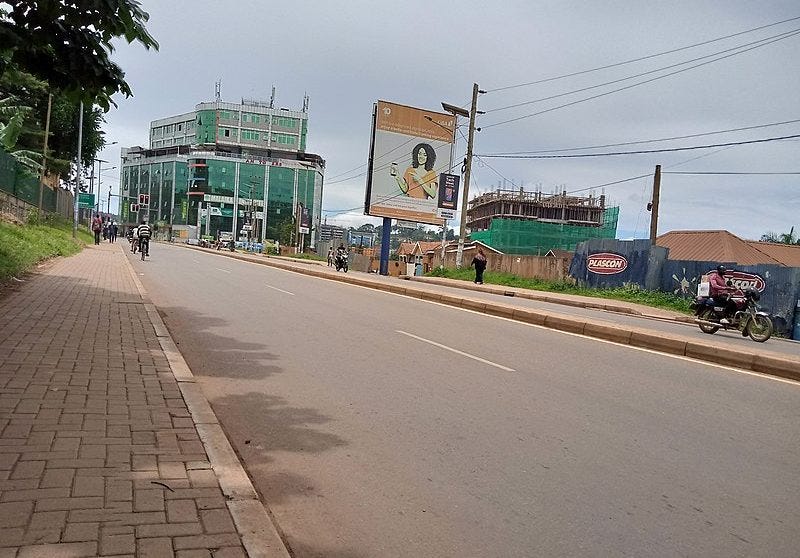
The following morning, I rode my motorcycle to town because motorcycles were allowed to do deliveries between 6:00am and 2:00pm. I wanted to use that chance to earn some money — but it was to no avail. All shops were closed. The streets were empty. There was no business in town!
Miraculous matooke
My phone rang. It was my wife calling.
“Praise God my dear.” She said, her voice cheerful. “Amen.” I responded, waiting for the news, hope on my mind. “God has answered our prayers!” She continued emphatically. “Just come back home please.” I had to go, eager to see the miracle!
When I pulled up on my motorcycle, it was there- a huge bunch of bananas enough to take us through a week. Relief coursed through my body on sight of the bananas.
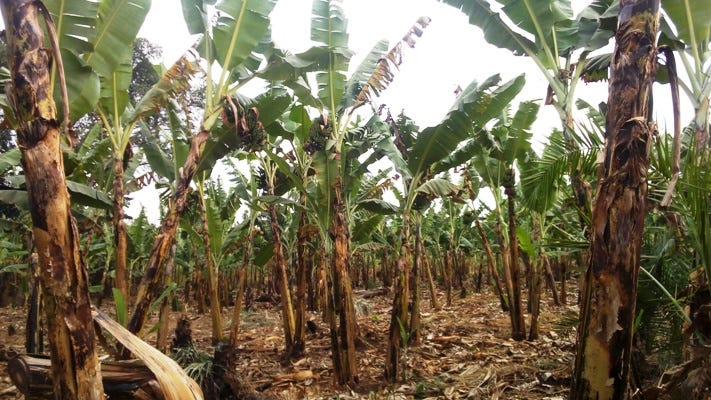
“How did you get this?” I inquired. “Our neighbour, David, told me to get the biggest bunch from his garden,” she answered. “How much do we owe him?” I asked. “Nothing, he said we don’t have to starve when there’s too much food in his garden and he’s not getting any buyers!” She responded optimistically. My brain boiled for a moment, doubting David’s intentions. But I kept all other questions to myself because we desperately needed the food. I had to continue trusting God, praying for protection. It helped.
A few days later, I realised that David was not alone in his abundance and generosity. Several neighbours had abundant food in their gardens. They used to sell their surplus but because of the disruption caused by the lockdown they were hardly getting any buyers. They, all eagerly gave us food. So we started receiving food from our neighbours every day until our store was looking healthy and yet they did not stop giving, so we identified other needy families and started forwarding the food. No more worries, we had to thank our neighbours, and to continue praising God!
Elsewhere, people with less blessed neighbors were reported to be eating only porridge. Some were eating banana peelings collected from their neighbours’ garbage bins. A few starved to death. We didn’t yet have covid-related deaths in Uganda but people were dying of hunger .
Government intervention
Throughout the lockdown, the president mobilized the nation to put together resources to help the needy, created the national taskforce on COVID-19, emphasized social distancing, collected foodstuffs, cash, cars, masks, sanitisers, and so on. He promised to provide food to needy people in Kampala and Wakiso districts only, saying that other districts were able to get food from gardens.
Following the president’s effort, individuals and companies donated whatever was possible but people’s focus was on food. Voices around the country could be heard asking the president to extend the food plan. Things like lockdown, curfew, social distancing, quarantine, masks and sanitizers were all strange to Ugandan ears and difficult to understand but had to be enforced in order to save the nation from the scourge — COVID-19.
The police and army were deployed. Public transport completely stopped. The enforcement of lockdown involved beating and shooting people who were suspected of defying the presidential directives. As the rest of the world was burying victims of COVID-19, Uganda was burying victims of brutal enforcement.
It was early April. The lockdown was extended by three more weeks. The government had not yet provided the food as promised — People were losing patience and started taking risks.
“Nze okufa enjala nfa essasi!”
“I’d rather die of a bullet than die of hunger,” said Hussein, another boda rider. His family was starving. His wife was sick. The landlord was on his neck. No one would help him. He needed money, and passengers still needed to move around the city. The only option was to defy the presidential directives.
Since a lot of people were desperate for travel, Hussein carried passengers despite the radio warnings and police shootings. Many boda riders did the same. This means that a lot of other people defied the lockdown.
To control the defiance the police set up roadblocks, arrested and beat up defiant folks, and impounded vehicles. Then, as per usual, the police began extorting people. All security organs including the then-newly trained LDUs (Local Defence Units) extorted citizens in disguise of enforcing presidential directives. The LDUs were the main predators. Citizens seemed not to fear the virus, but we were all afraid of the predators dressed in security uniforms. However, despite the coercive action by the security forces, many people continued to defy the lockdown because the need to search for food was greater than the fear of torture or bullets.
Personally, I dared not carry passengers. I could not allow myself to break the rules. However, two months into the lockdown, I met my future co-author Tom, who I worked with and helped me to pay off some of my bills. I was lucky. Those who were not as lucky found means of earning from the banned boda business.
Absurd tactics
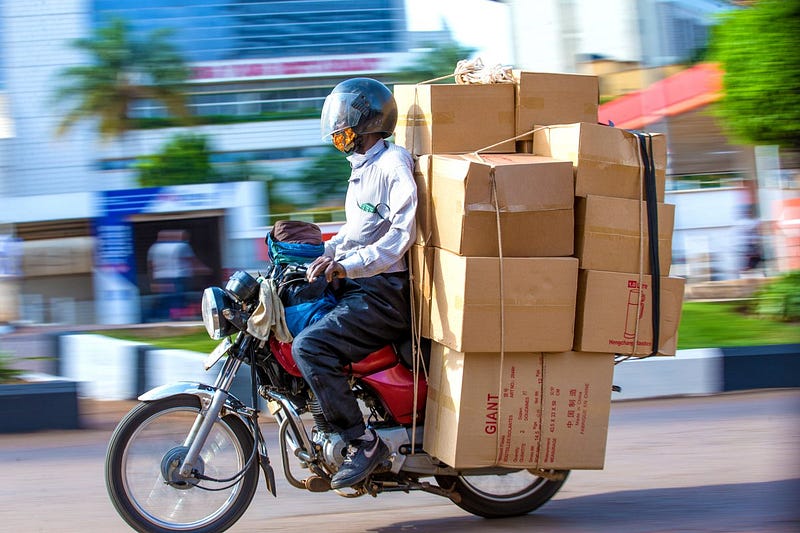
Carrying passengers in boxes.
During lockdown boda bodas were only allowed to carry goods. Because humans normally make over 90% of boda loads, banning passenger was incomprehensible, yet had to be defied stealthily. So if you ever saw large wooden boxes on motorcycles in Kampala during lockdown, some could be carrying passengers. It was a weird, desperate decision taken by passengers who had to choose between starving at home and travelling to find food.
Medical forms, bandages, and cannulas.
The invasion of COVID-19 did not stop other diseases, and a lot of people had to travel to hospitals and back to their homes using public transport. This was only allowed if the patients had proof of sickness. The proof could be medical forms or convincing signs of sickness. Though true patients were very many, there were also many fake patients. Some healthy people were able to get medical forms just for travel purposes. Others bought bandages and cannulas and wore them every time they travelled on a bodaboda.
Seeing the opportunity, some boda riders began carrying these items. You could find a boda rider who would carry bandages and wrap up every passenger’s arm before the start of the trip.
Fake pregnancy.
Pregnant women had exclusive travel rights. In lockdown, businesses were severely restricted from operating. There was curfew so people had limited time for moving around. There was quarantine so people hardly moved from one region to another. But then there was pregnancy! To the pregnant woman, all barriers were impotent. Fakers used the chance!
Dodging roadblocks.
Every road had permanently marked roadblocks enforced with heavy security, all intended to suppress movement. Targeting those who defied the rules of the lockdown, the forces at the roadblocks were nearly inescapable. However, since the roadblocks were immovable, some travellers were able to dodge them by taking detours.
One issue I faced was my failure to keep time. When curfew was set to start at 2 pm, I was always starting my trip back home at exactly 2 yet at that time I was supposed to already be at home. This means I was always riding against the rule. But I was never worried because I knew all the feeder roads that connected me from downtown to home, past Matugga. Wherever I was on my way home, I realized that every cyclist was similarly taking a detour to dodge the ruthless curfew enforcers. We were successful at it until the LDUs began chasing us using the motorcycles confiscated from other riders. Then I refrained from breaking the time limit.
“Tunajjawa akawogo?”
Akawogo is another common slang in Kampala mainly used by boda riders to mean ‘some money’. When the lockdown enforcement intensified, everyone said “tunajjawa akawogo?” meaning; “where shall we get some money?” People were desperate for daily earnings. Many joined the new businesses of mask and sanitiser sales to forge sustenance. Food was the mainstay of conversations. Failure to earn akawogo meant starvation, caused tension, and led to a rise in domestic violence. But the lockdown continued no matter what. The government’s food relief plan was imperative.
Food distribution
After a long wait, government’s plan to provide free food to the needy families began. I gladly listened to news featuring the progress of the food distribution. Being a resident of one of the selected districts, I thought my family would receive posho, rice, beans, sugar, powdered milk, and all items that were listed for distribution.
The first round of the food distribution was promising. I moved around parts of Wakiso and witnessed the distribution. Trucks full of food moved mainly in areas occupied by the needy. These areas were usually slums.
Escorted by security forces and guided by local authorities, the food was given free of charge to whoever was lucky. Most of the people who received food were getting only posho and beans. I didn’t meet anyone who received all items listed in the plan. The police, the army, the prison guards, the LDUs, the LCs were all involved in the process. They moved door to door and gave food to needy people, but the criteria used to select the needy was not clear. A lot of irregularities were observable. Stories where one poor family received plenty and another poor family received completely nothing were common. Also, many of the people who received food complained that the beans were rotten, and the posho was of extremely poor quality.
In my residential area, everyone eagerly waited for the food trucks in vain. The first round came and went. We thought they would reach us in the second round but we were missed again. I am yet to know if they rated us among the well off.
Precisely, whatever happened with the food relief plan proved that the government couldn’t feed the nation.
Whoever received the food was short of sustenance again in only a few weeks and there were no more rounds of food relief. The burden was heavier than what the government could handle. Debates of whether to resume work ensued. The government introduced SOPs (Standard Operating Procedures), and partially lifted the lockdown.
The partial hope
“Abange, omwavu anadda engulu!”
“Folks, the poor shall bounce back to life!” My neighbour Ssalongo, also a boda rider said after hearing that the president would announce the lifting of the lockdown shortly. It was good news. Every media house was set to cast the presidential speech. Everyone was eager to hear whatever the president wanted to say.
It was around 8:00pm. The president started to address the nation. I listened to him attentively over Kingdom fm. However, when he said that “Sneezing spreads the virus. Therefore social distancing and masks could help stop the spread,” I felt like he was wasting time stressing things which he had already said many times before. By that time I was aware that the virus had invaded Uganda. I knew its mode of spread. I had learnt the signs and symptoms plus the preventive measures. All I was itching to hear from him was the relief plan and the possibility of resuming work.
I was dismayed when, towards the end of his speech, he equated boda business to the quantity of tea scooped by a spoon. He stressed that such negligible quantity cannot satisfy anyone. His remarks meant that boda business is so negligible that Uganda’s economy doesn’t need it. This made me think that the president was either misinformed or unable to notice the myriad of people and activities that wholly depend on bodaboda.
His speech only gave hope to car owners, taxis, buses, and cargo trucks. He allowed small cars to carry two passengers, minibuses, and buses to carry half of their licensed capacities, and cargo trucks had to contain only the driver and one other person. But boda riders were instructed to continue doing the hardly available deliveries.
Nearly two months after the president’s oppressive judgement, boda business was reopened — yet the KCCA announced that it would implement its long desired boda free zone across the Central Business District (CBD), where demand for bodas was heavy.
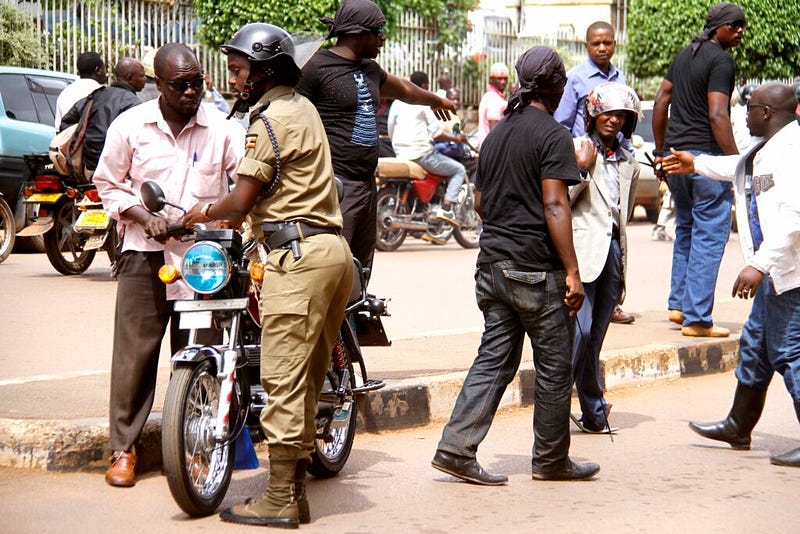
On the morning of the boda free zone implementation, there was heavy security deployments to all entries to the CBD to suppress riders’ access. Many riders were arrested, and motorcycles were confiscated during the enforcement. However, this lasted for only a few hours because the forces against it were greater than the forces that promoted it, and the security forces gave up. Soon, every street in the CBD was once again humming with boda riders.
The curfew continued with some adjustments, but boda bodas remained a target.
When boda riders were only allowed to do deliveries between 6:00am and 2:00pm, everyone else was allowed to be outside up to 6:00pm.
When other vehicles could carry multiple unknown passengers in closed cabins, boda riders were warned against carrying any passengers. Authorities ignored the fact that since a motorcycle carries one passenger at a time, the spread of the virus could be much slower than in taxis and buses which carried many people from different locations per trip.
Today, everyone other than boda riders, is allowed to be outside up to 9:00pm. Boda riders are not allowed on the road beyond 6:00pm. Every boda rider caught on the road after 6:00pm is subjected to torture, extortion, and confiscation of his motorcycle. This anti-boda action is continuing to cause non covid-related troubles long after the lifting of lockdown.
Looking in the rearview mirror, driving forward
Over centuries, the world has achieved victory over viruses, wars, and many other disasters. This time around, some companies have already announced triumph over the coronavirus by creating vaccines. How quickly the vaccines work remains to be seen, but the death toll is already enormous — three million lives have been lost.
Whenever the world encounters disasters, we normally focus on the deaths that are directly caused by the disasters. There is usually no follow up on the troubles and deaths caused by attempted remedies, inappropriate procedures, ignorance, and the violence that takes place under disguise of enforcement.
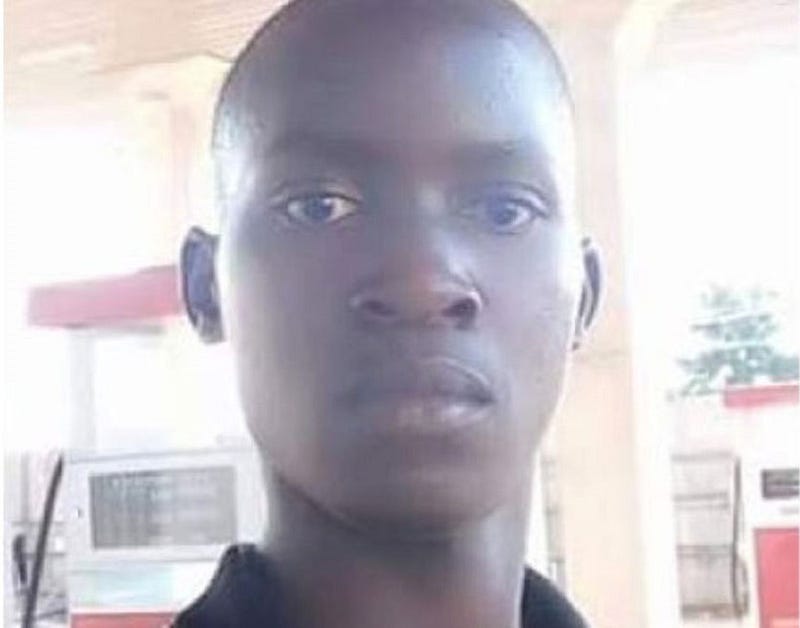
I remain concerned about the violence against boda riders. I am a boda rider. We have been oppressed to the extent that some of our colleagues have been driven to suicide. The Hussein Walugembe story of Masaka — the boda rider who burned himself alive in a police station when they seized his motorcycle and extorted him for its release — is still fresh in our minds. Boda riders continue to die in inexplicable circumstances.
We have faced road crashes while trying to escape from policemen who chase us in disguise of enforcing the curfew, yet their major pursuit is extortion. This happens to us while everyone else moves peacefully.
Many boda riders have been shot at and killed. Others have sustained serious injuries. But the security forces seem not to understand that there is no point in shooting at people while trying to keep them from dying of covid-19.
I look forward to the day we are respected and given a seat at the table, and not just punished, extorted, and shot at.