Guest Article: The Promise of Online Bodas
Tom Courtright · 25 January 2023
By Alon Muhame
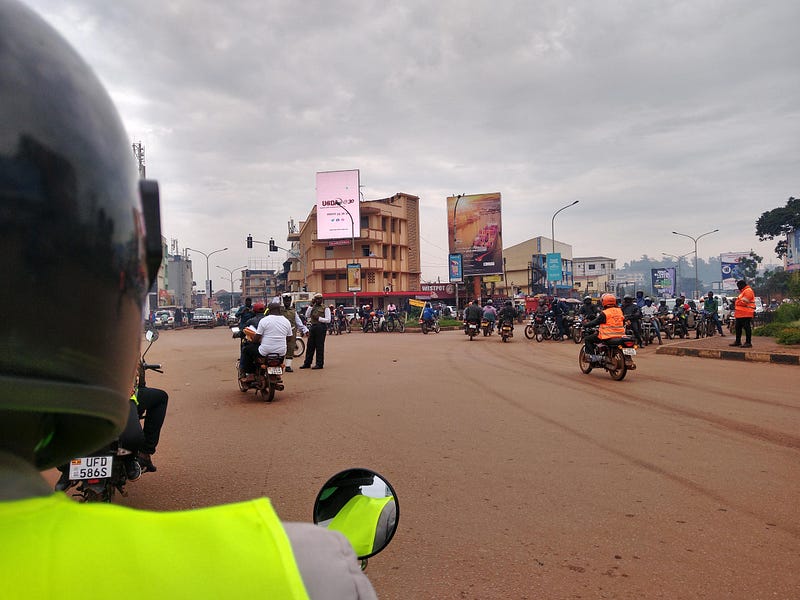
Anyone who has ever visited Uganda’s capital city will be familiar with the sight of boda-boda stages, groups of motorcycle-taxis closely agglomerated within each other’s arm’s length. Traditional boda-bodas do not operate from any formal infrastructure but may be seen in groups in city corners and road edges/shoulders waiting for passengers next to the road. As noted by John Howe, bodas provide “a short distance, low-capacity service able to serve density demands, and those where access is physically restricted and cannot be met by conventional public transport.”
Digital platforms, our 21st century innovation, can be defined as entities that “enable interactions among users and generate value from these interactions.” Digital platform-based motorcycle taxis, such as SafeBoda or Uber are independent service providers on a web application-based platform. By leveraging digital technologies and data analysis techniques, these platforms claim to reduce transaction costs and make the interaction between riders and consumers viable. Unlike traditional boda-boda riders (also known as ‘normal jazz’) that control transaction price by negotiating fares with clients — sometimes depending on the mood of the rider, assumptions about the passenger’s wealth, or weather — platform-based motorcycle taxis are positioned to provide standardized prices by leveraging the positive network effect on the platform, and their prices are algorithmically determined. While boda apps have expanded since the introduction of SafeBoda, they remain in co-existence with no-app bodas. Who wins and loses in this kind of market competition?
A brief history of the boda-boda industry
The boda-boda industry grew from humble beginnings in the 1960s in the border regions of Kenya and Uganda when bicycles were used to smuggle goods and move people across borders between Kenya and Uganda — from border-to-border giving them the nickname boda-boda. Traditional boda-bodas do not operate from any government-authorized infrastructure but may be seen in stages in towns waiting for passengers.
Platform based boda-bodas are decentralized and requires innovative governance mechanisms that use digital tools, often data intensive, to replace traditional economic interactions (e.g., rating systems to build trust between individuals who are unlikely to interact repeatedly). The first platform boda-boda was first implemented in Uganda in 2017 by SafeBoda.
One 2019 study estimates that there are over 100,000 Boda-Boda motorcycle taxis in Kampala city alone. This accounts for approximately to 16% of employment capacity in the central business district. Essentially, boda-bodas provide feeder services to other means of transport such as buses and commuter — taxis (minibuses), as well as compete with them.
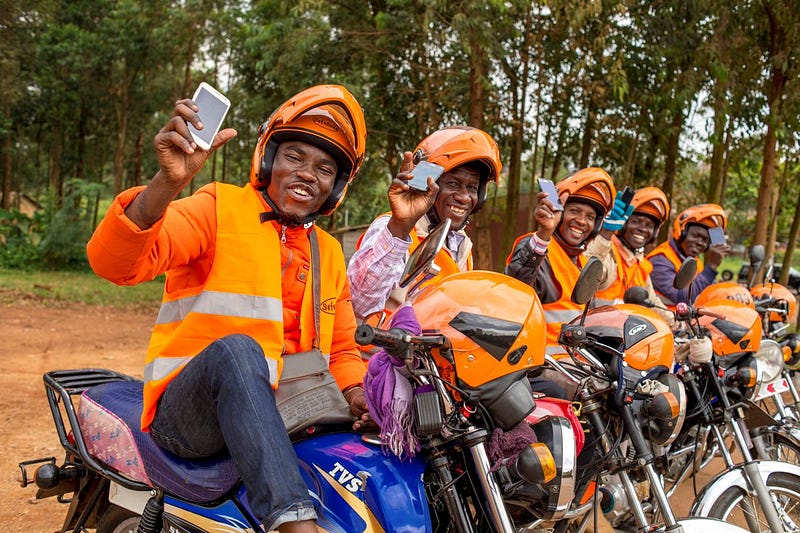
The most prominent examples of these new intermediaries in the boda-boda industry in Uganda are SafeBoda, Uber, Bolt among others, and they offer point-to-point transport. These boda-boda platforms don’t control the production of a service (i.e., they don’t own the boda-bodas themselves or directly employ them) but they make it possible by facilitating the interaction between those who want to consume a service (riders or travellers) and those who can supply the service (boda-boda drivers) who act as independent contractors.
Trade-offs between traditional and platform based boda-bodas
Dynamic pricing. A critical distinguishing feature of platform ride-hailing boda-bodas from other motorcycle taxis is that it uses dynamic pricing to equilibrate local, short-term supply and demand. A consumer wishing to take a particular trip can face prices ranging from the base price (e.g., SafeBoda’s reserve price is UGX 2,000) to five or more times higher, depending primarily on the distance and time of trip. In addition, platform boda-bodas pricing system has components similar to standard cab pricing systems first introduced in Uganda, in 2015 by the late and former mayor of Kampala Nasser Ssebagala and the ‘cab-product’ has a fare defined by price per km, price per minute, a fixed fee, and a minimum total fare. Additionally, apps sometimes raise prices during times of high demand, encouraging riders to use the app and allocate rides to drivers who value them most highly. On the other hand, traditional motorcycle taxis riders and users usually bargain until they agree on a certain price. In most cases, bargaining follows the ‘ask-offer’ form on either side of the parties, taking into consideration of demand at the time of the day, price of fuel, weather and geographical direction of the journey, distance, driver’s mood, among others. For example, traditional boda-bodas tend to charge high fares on a rainy day and rush hours of the day. It should be noted that the customer is always in the lead and drivers mostly counter-responds to the clients offer, however, when the driver notices the customer’s unfamiliarity of the boda-boda transport industry, the driver tends to lead in setting the trip price. This may result in pricing that feels unfair to passengers, especially in case of asymmetric information on both sides, such as riders charging newcomers 10,000 UGX for what should be a 3,000 UGX ride.
Convenience. To use boda-bodas on the platform, a consumer downloads the app onto her smartphone for free. When seeking a ride, the consumer opens the platform of choice app and makes an order choosing a ride with final destination indicated. Being able to order a rider at the tap of the app theoretically creates convenience in access and consumption of a service on the side of the customer. This, however, comes at a cost borne by the platform and the driver of airtime and/or internet data to call and locate the customer physically. The traditional boda-bodas require the customer to either call them or locate them from their stages, stop a moving boda-boda (also called “lubyanza”) before any transaction can take place. For app-based bodas, if a consumer places an order, rider-partners are sequentially given an opportunity to accept that order until one does so. Throughout this interaction, digital platforms are able to trace out the journey, mainly through a data footprint of the drivers journey map in case of uncertainty or insecurity.
Trust and discipline on the road. Digital platforms provide a double rating functionality for drivers and the riders that help to convey the experiences of a rider and the driver on the platform. Ratings at the end of the trip are partly a testimony of the emotions and experiences during the trip. In addition, customer ratings feed into the matching algorithm and acts as signal for evaluating the drivers’ behaviors and the quality of service on the platform. This helps to self-enforce behavior and adhere to road user and traffic regulations on the road. Indeed, one can attest that good road users among boda-bodas are platform based bodas. The ratings could be the reason and influence platform drivers to behave responsively to platform standards, road traffic signs in the longer term and thus checking the road accidents in the metropolitan area. There is the possibility that ratings and reviews explain the market power of the digital platform on workers by making gig workers susceptible to customers’ actions and thus more accountable to society. While both platform boda-boda drivers and customers were more compliant to safety precautions and measures on the road initially, there is, an increasing concern that the standards have declined. For example, most SafeBoda drivers have abandoned the practice of carrying a customer helmet and customers have also shunned using them — as both parties claim it as a measure to control diseases such as COVID-19.
Network effects. This refers to how the size of a platform (i.e., number of users) has an impact on the value proposition of that platform to its users. Boda-boda riders on the platform also enjoy network effects of the current users on the platform and future users (in this case, customers already having the app on their mobile phones automatically become the potential customers for the service). In addition, network effects benefit both drivers and users — drivers are positioned to a large market of potential customers — and customers are presented with a wider pool of boda-bodas to choose from when ordering.
Cost of entry. Boda-boda industry entry requires, at very least, access to a motorcycle, and a fair understanding of the area of operation. Apart from the cost of purchasing the motorcycle, the additional entry cost is in the form of paying for stage membership. For platform based boda-bodas the cost is even higher as it involves having a smartphone, purchasing at least two helmets and training fee. Aware of boda rider cash illiquidity, platform based boda-bodas are allowed to pay in installments, which are often deducted directly from the rider’s app-based earnings.
Key take-aways
Boda-bodas have a huge impact on mobility in Uganda, and app-based bodas have the potential to expand this further. For example, a study by Shell Foundation in 2017 — an early investor in SafeBoda — showed that SafeBoda greatly improved women’s mobility across the metropolitan area. The study further reported that app-based bodas were considered safer, convenient and reduces mistreatment of women as the majority of drivers are trained in good customers relations and behavior.
Digital platforms connect multiple users, generating unique value through network effects and help to overcome some market frictions. In addition, platforms provide an opportunity for drivers to participate in two sides of the market — app and non-app boda-boda markets, especially during return trips.
The boda-boda transport sector provides two interesting examples of the power of competition and faces challenges related to high levels of informality, which impacts trip fares. Some platform boda-bodas are known to start journeys early and delay termination of the trip in order to receive more trip income. They may cheat customers by taking longer routes and creating unnecessary delays to increase the trip distance, because this improves their ability to make a daily living. Many boda riders use the app in the way that a drunk uses a lamp post: for support, not illumination, i.e., they use the app as a backup plan. They operate offline and cancel most cashless trips claiming that the cashless rides yield less trip income, owing to the deductions and mobile money taxes charged upon withdraw of the money. These practices have damaged the image of platform riders among some sections of the customers, and a permanent solution has yet to be found.
Platform-based bodas have lagged from their initial success. Many factors are at play: high levels of informality in the industry, competition from non-app boda bodas & other transport modes like commuter taxis, high taxes on mobile money transactions, and negative platform network effects all act as negative drivers on the platform. Platforms too need to overcome a fixation on launching new technologies as a measure of success in transforming the informal transport sector. And above all, we need to spend more time understanding the human welfare aspects of users and providers of the services in this informal labor market, recapturing the major incentives for their employment in this informal service sector in the first case.
Alon Muhame, is a Senior Partner at BBOOBBO Green Group, and is a research and development consultant at Hive Colab, Uganda & WITU Uganda. His research interests are in informal labor markets, digital markets, and application of machine learning in design of markets in sub-Saharan Africa.